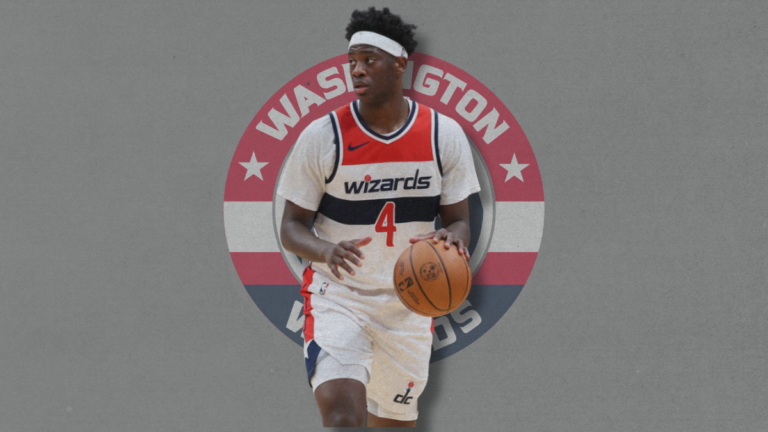


MACAO, China — When the front office traded up to secure the 25th pick in the draft, scouting reports highlighted a 6-foot-6 Spanish jumbo playmaker capable of manipulating pick-and-roll coverages with veteran poise. Following back-to-back exhibition displays in Macao, that evaluation was put on full display. The Sergio De Larrea Mavericks initial introduction featured electric playmaking, where he compiled 11 points, 6 assists, and a perfect 3-for-3 mark from deep in his first outing. Yet, beneath the dazzling highlights lies a raw developmental curve that dictates whether he can eventually serve as the long-term successor to Kyrie Irving.
While his vision and size make him a natural fit for head coach Dusty May’s high-speed system, his six combined turnovers across the exhibition tour exposed a growing pain. Transitioning from European paces to NBA pressure requires more careful passing and a tighter handle, making his daily work behind Irving the single most critical variable in his development.
Pressure Handling and the Turnover Tax
Sergio De Larrea is a quick, instinctive distributor who naturally thrives in high-tempo flow, leveraging his 6-foot-6 frame to survey over top-lock defenses and trigger instant ball movement. However, when Houston’s perimeter defenders picked him up full-court and applied physical pressure to his dribble, his high bounce bounds made him susceptible to baseline traps and pickpockets.
Sergio De Larrea Macao Exhibition Production:
- Game 1 vs. Rockets: 11 PTS, 6 AST, 2 REB, 4 TOV (3/3 3PT)
- Game 2 vs. Rockets: 9 PTS, 7 REB, 4 AST, 2 TOV
- Combined Turnovers: 6 TOV across 46 total minutes
That turnover count is not a flaw in his decision-making; rather, it is the tax levied on a passing savant adjusting to NBA length. For the young floor general, becoming a pressure-resistant Mavericks point guard is not about slowing down his passing triggers, but tightening his handle mechanics. Learning to absorb contact without altering his dribble path will allow his elite passing instincts to shine uninterrupted.
Why the Sergio De Larrea Mavericks Blueprint Demands Kyrie Irving Mentorship
There is no better classroom for pressure resistance than sharing a practice floor with Kyrie Irving. Where Sergio De Larrea currently struggles with high dribble bounds against aggressive ball-pressers, Irving has made a career out of manipulating defender leverage with low, elastic dribble angles, change-of-pace deceleration, and body shielding.
In May’s scheme, a primary distributor cannot afford to let physical pressure force premature pickups. The entire offensive engine relies on rapid ball movement, quick-trigger handoffs, and relentless middle-floor reads. If Irving can teach De Larrea how to use the tricks of the trade to shield full-court pressure while maintaining an active dribble, the Sergio De Larrea Mavericks blueprint shifts from an intriguing developmental project into an elite engine.
The Pathway to Kyrie Irving Succession and European Jumbo Echoes
Unlocking high-stakes minutes on a team requires earning the head coach’s trust in late-clock situations. Dallas spent years relying on a broad-shouldered European floor general who manipulated pick-and-roll pacing before trading Luka Dončić in 2025. Watching De Larrea operate brings back eerily similar echoes of Dončić, leveraging a jumbo 6-foot-6 frame to survey over defenses, crash the glass, and throw pinpoint lobs to rim-runners. His innate ability to process reads ahead of the defense and knock down three-point jumpers gives him an undeniable rotational footprint, positioning him as the eventual heir to Kyrie Irving’s backcourt throne.
However, mastering the backup role behind Irving is about pressure mitigation. Where Dončić used sheer size and leverage to absorb traps, De Larrea must adapt to NBA athleticism. When opposing defenses deploy aggressive ball-pressers to disrupt the flow of the unit, he must respond as a composed Mavericks point guard by using tight handle and deceptive changes of speed to keep the offense moving without hesitation.
Patience is required when grooming a 20-year-old rookie floor general. The raw flashes shown in China prove that the front office made a calculated bet on elite baseline instincts and passing vision. Sergio De Larrea Mavericks developmental arc is the key to securing the backcourt rotation for the next decade.
Find me on X: @f_rederic_k