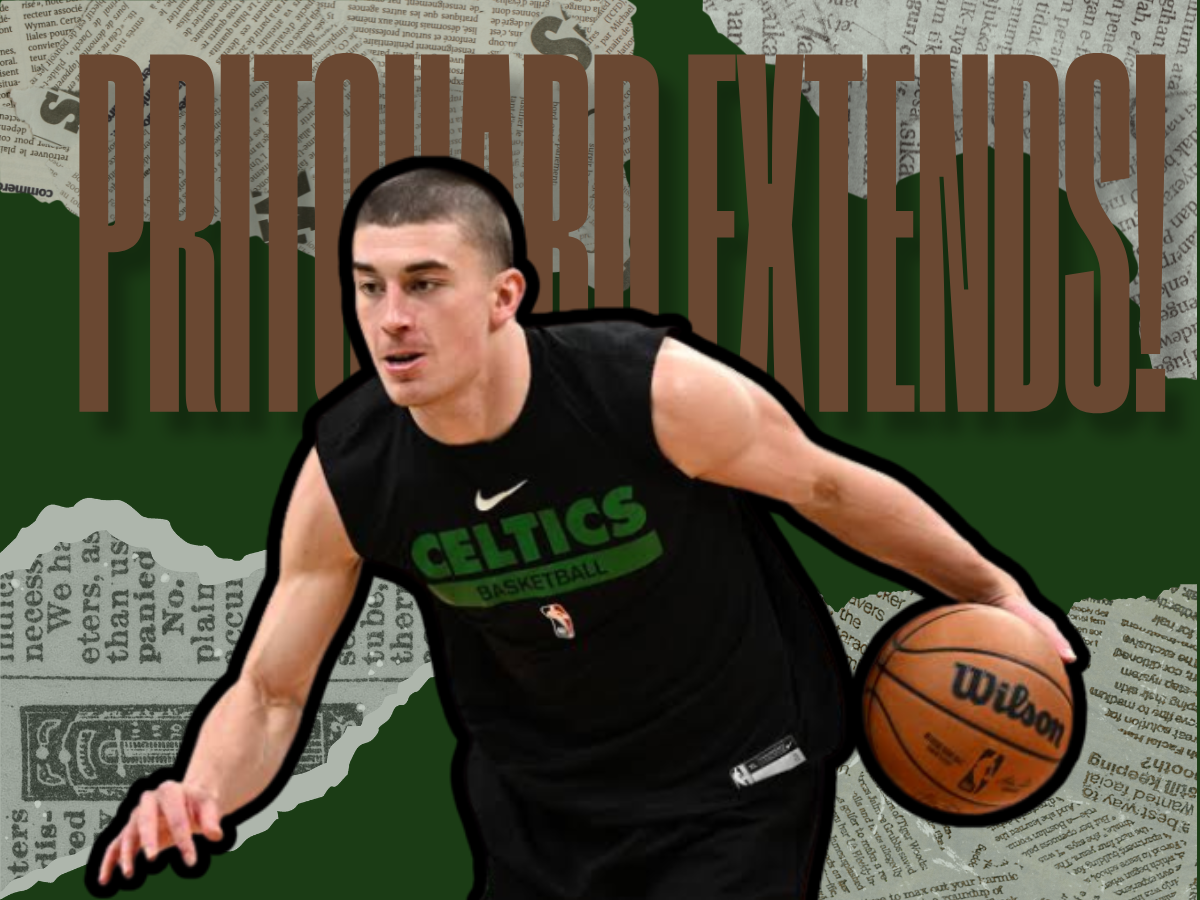

BOSTON — Just three weeks after projection clocks began ticking toward October extension deadlines, Brad Stevens and the Boston Celtics front office locked down their premier guard. As reported by ESPN’s Shams Charania, Boston agreed to a two-year, $44.2 million Payton Pritchard contract extension that includes a mutual option for the 2029–30 season. By securing the 2024–25 Sixth Man of the Year winner on a deal averaging $22.1 million annually, Brad Stevens delivered a masterclass in roster management under the restrictive collective bargaining agreement.
The Payton Pritchard extension ensures that one of the league’s most lethal perimeter guards remains under control through his athletic prime.
Coming off a career-best campaign where he averaged 17.0 points, 5.2 assists, and 3.9 rebounds across 79 games, Pritchard’s production had vastly outgrown his previous contract. Locking in this agreement avoids an expensive free-agency bidding war down the road while keeping Boston’s backcourt intact.
Cap Flexibility and the 2028-29 Paul George Timeline
A glance at Boston’s multi-year cap sheet reveals why Brad Stevens orchestrated this extension with such precision. Under his current deal, Pritchard remains a massive bargain at $7.7 million in 2026–27 and $8.0 million in 2027–28 before his extension kicks in at $21.2 million for the 2028–29 season.
The brilliance of this timeline lies in its direct alignment with Paul George’s contract. George’s $56.5 million player option expires after the 2027–28 season, entering unrestricted free agency in 2028–29 right as Pritchard’s new money hits the books.
- Cap Reset Sync: When George’s $56.5 million slot expires in 2028–29, Boston absorbs Pritchard’s raise while opening up substantial overall payroll flexibility.
- Second Apron Insulation: Offsetting Pritchard’s $21.2 million cap hit against expiring veteran contracts keeps Boston comfortably below tax aprons.
- Mutual Option Protection: The 2029–30 mutual option ($22.9M) gives both the franchise and Pritchard maximum flexibility to re-evaluate market values without locking up dead money.
This financial sync proves that Brad Stevens isn’t just managing contracts—he is engineering sustainable championship windows. This is how the NBA works now. Team-friendly deals are essential to competing for championships.
Why Pritchard Is Essential to the Celtics Offense
From an organisational standpoint, rewarding Pritchard was a necessity for Joe Mazzulla’s high-volume three-point system. Pritchard’s rare combination of deep three-point range, ball security, and fast-break pacing makes him an indispensable engine for the Celtics offense.
In Mazzulla’s system, having a guard who shoots without hesitation raises the floor for the Celtics bench. During the 144–106 preseason victory over Philadelphia, Pritchard’s 25-point, 7-assist masterclass in just 24 minutes demonstrated how easily he can take over games as a primary secondary generator.
Rewarding that production with an extension reinforces a culture where internal development is met with long-term financial commitment.
Payton Pritchard Contract Extension: Maintaining Championship Depth for the Long Haul
While rival Eastern Conference contenders face constant turnover due to cap restrictions, Boston has systematically locked in its core pieces. Pairing Pritchard alongside Derrick White, the surging Baylor Scheierman and veteran leader Mike Conley ensures that the Celtics offense maintains elite playmaking across all 48 minutes.
By finalizing the Payton Pritchard contract extension before opening night, Brad Stevens eliminates any distractions. Boston enters the 2026–27 campaign with its rotation secured, its multi-year cap structured, and its championship foundation firmly locked open.
Find me on X: @f_rederic_k