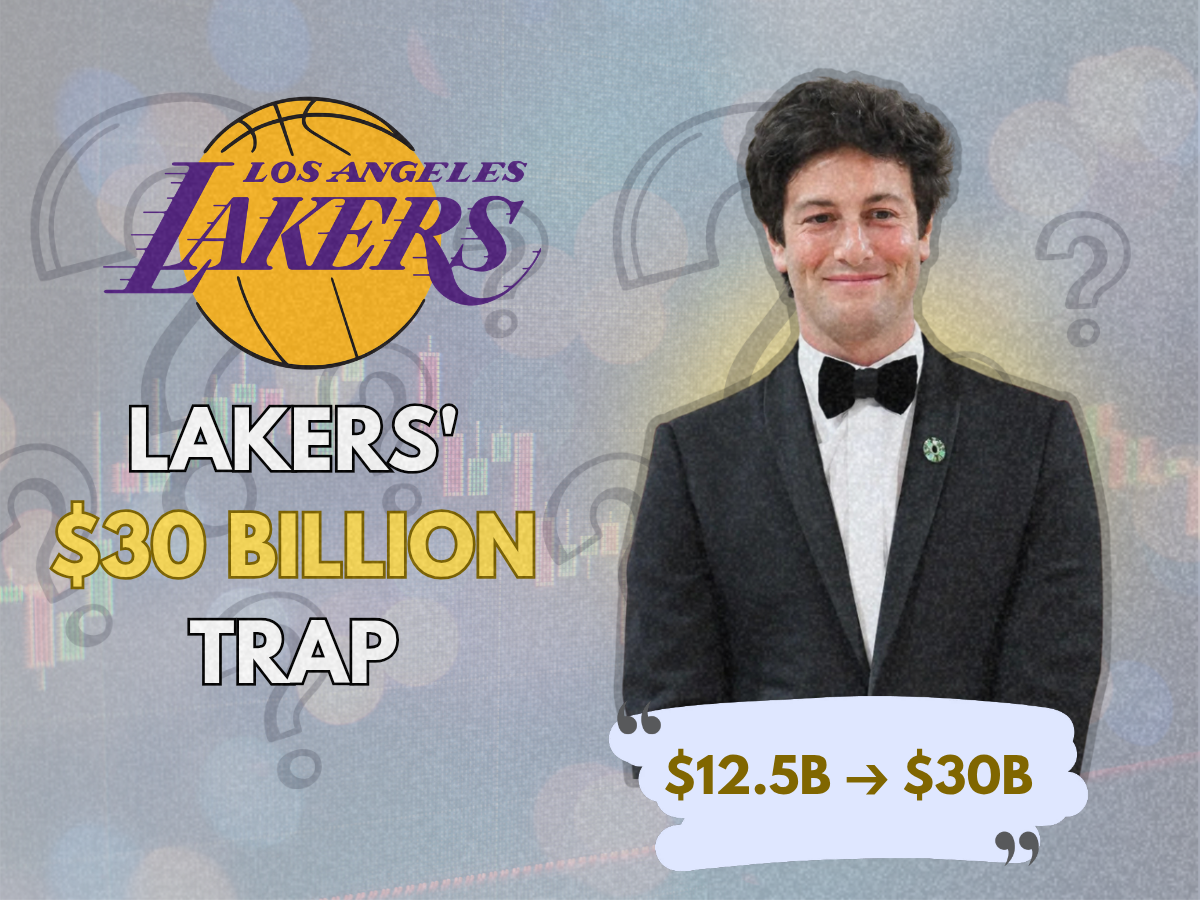

LOS ANGELES — When private equity head Josh Kushner and media mogul Bob Iger spearheaded a deal to purchase the Los Angeles Lakers at a staggering $12.5 billion valuation, the sale sent shockwaves across sports media. However, an internal investor presentation circulated by Thrive Capital exposes how the greedy Lakers ownership plans to extract maximum revenue from the fanbase, according to the Wall street Journal (subscription required). By aiming to balloon the team’s valuation to $30 billion over the next decade, new Lakers ownership is prioritizing profit margins over the passionate fans who built the franchise’s legendary culture.
Squeezing Local Fans Out of Crypto.com Arena
The primary engine powering this $30 billion pitch relies on aggressive revenue extraction from ticket holders. As reported by The Wall Street Journal, the aggressive baseline figures lay out a staggering price hike:
The plan outlined by Thrive identifies around $150 million in near-term incremental revenue by 2028. That would come partly by reclaiming roughly 6,000 broker-held season tickets for single-game sales, which would raise average single-game ticket prices from $217 to $361. Lakers ticket prices have already been on the rise. The buyers would also capture $40 million to $75 million from sponsorship opportunities and extract at least $20 million in operating cost efficiencies.
By Jessica Toonkel and Mark Mauren. of WSJ.
This maneuver accompanies a projected 66% surge in average non-season ticket prices, jumping from $217 to $361 per game. Pushing average ticket costs past $360 officially prices working-class Angelenos out of live games. Following the report, the Lakers beat writer forThe Athletic Dan Woike offered insight into the franchise’s messaging, noting:
While initial reporting attempted to attribute the aggressive ticketing model to previous controlling owner Mark Walter, that distinction is ultimately irrelevant. There is no mandate forcing the current regime to adopt Walter’s blueprint. The fact that Kushner and Iger retained these exact revenue projections in their investor deck proves that Walter’s pricing model aligns seamlessly with new ownership’s greedy plans.
Slashing Costs and Diluting Purple and Gold Heritage
Beyond aggressive ticketing, greedy Lakers ownership intends to double team revenue from $681 million to $1.6 billion while cutting $20 million in operational costs. As detailed in the investor pitch:
The buyers are inheriting an already lucrative business. The group said the Lakers are on track to generate $681 million in revenue in 2026, with ticketing and media rights accounting for the largest share. Under their plans, they said, revenue would hit at least $1.6 billion by the end of 2037.
Attempting to expand adjusted earnings before interest, taxes, depreciation and amortization from $129 million to $589 million signals a cold, private-equity approach to managing a storied NBA brand. Furthermore, capturing up to $75 million in new corporate sponsorships risks saturating uniforms and home court floors with corporate logos, marking a complete departure from the player-first atmosphere cultivated by the Buss family.
When private equity returns dictate front-office decisions, building title-contending rosters under strict CBA aprons becomes a secondary priority behind revenue growth. Will ownership be willing to enter into the second apron to keep a contender? That seems unlikely at the moment.
Greedy Lakers Ownership Means the Death of Dr. Jerry Buss’s Culture
For decades under Dr. Jerry Buss—and later through the stewardship of Jeanie Buss—Los Angeles operated as a family-run business. While Jeanie has fought and is fighting to preserve her controlling governance, the massive influx of private equity capital under Kushner and Iger alters the organizational ethos permanently.
Treating an iconic franchise as a hyper-growth asset risks severing the emotional bond between the team and its global fanbase. If the greedy Lakers ownership treats championship banners as mere line items on an investor deck, they will dismantle the loyalty that gave the brand its unprecedented value.
Find me on X: @f_rederic_k