
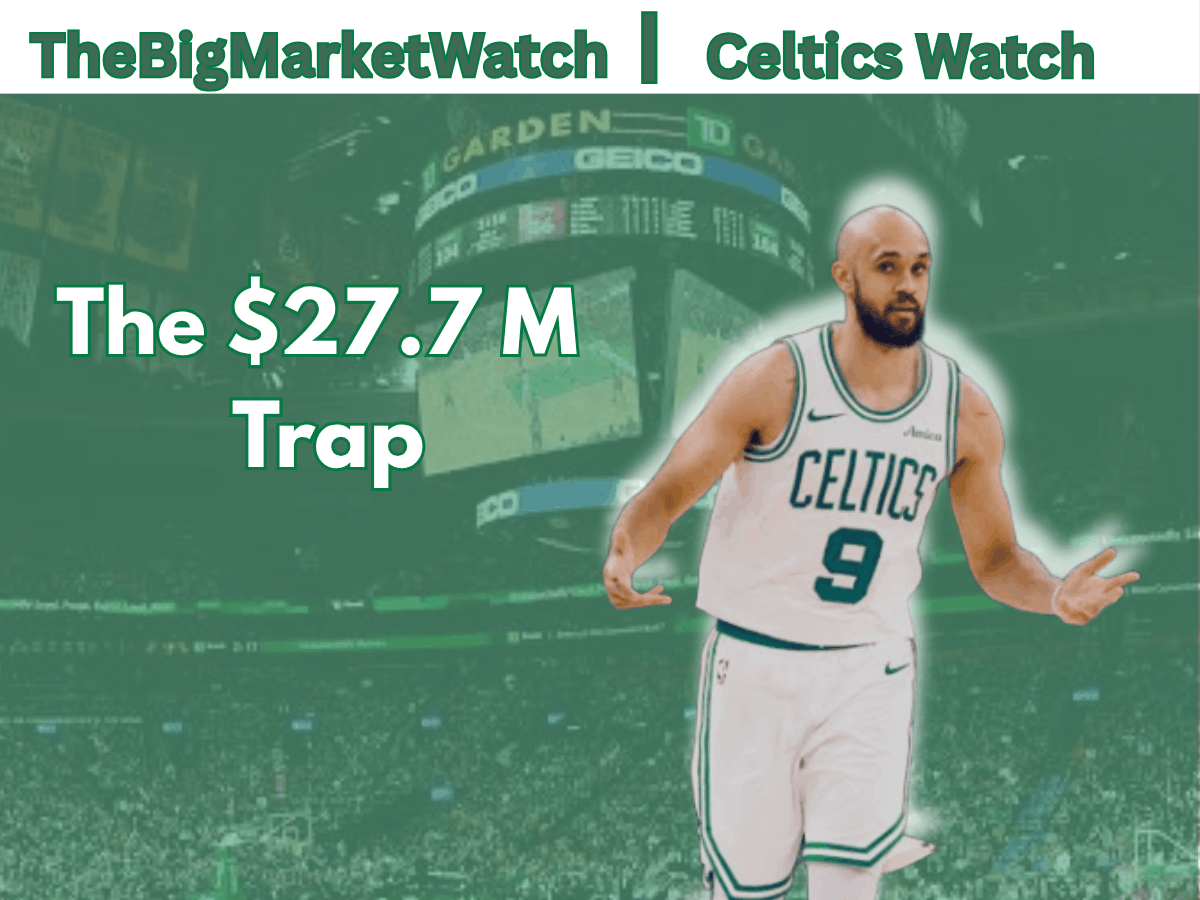

BOSTON — When Boston restarted the timer on massive Celtics $27.7 million trade exception at last season’s trade deadline, rival front offices took immediate notice. By absorbing Nikola Vučević into a prior exception while sending Anfernee Simons to Chicago, Brad Stevens generated an asset that reaches its one-year expiration mark at the upcoming February trade deadline. However, a hidden salary cap trap means that fully unlocking the Celtics $27.7 million asset before time runs out requires a far bigger roster sacrifice than casual observers realize.
Celtics $27.7 Million Trap: The First Apron hard cap bottleneck
The central complication stems from Boston’s summer moves. When Brad Stevens used the Non-Taxpayer Mid-Level Exception to sign Mitchell Robinson, Boston triggered a hard cap at the First Apron. Under Collective Bargaining Agreement rules, a hard-capped team cannot exceed that threshold under any circumstances for the remainder of the league year.
With approximately $10.3M in remaining First Apron cushion, Boston cannot simply absorb a player earning $20M to $27M into their trade exception. Taking back that much salary without sending money out would instantly breach the hard cap, causing the NBA league office to reject the deal outright. Because trade exceptions cannot be combined with existing player contracts to absorb a single salary, Boston cannot simply stack smaller pieces to bridge the gap.
The mechanics of the TPE refresh
To utilize the asset while remaining below the First Apron, Boston must simultaneously shed equivalent payroll. Shedding a premium starter like Derrick White—who was an All-Defensive First team selection last season—sounds absurd on the surface for a contender, yet he represents the only single contract on the roster large enough to make the math work on a marquee acquisition.
If Boston absorbs an incoming $27 million star into the expiring exception while trading Derrick White into a separate transaction slot, they accomplish two crucial goals. First, trading White clears his $30.3M salary off the books, offsetting the incoming contract and keeping team payroll safely under the hard cap line. Second, moving him generates a brand-new $30.3M exception that resets the 365-day clock for next season.
This maneuver, which I call a TPE reset, allows a front office to convert an expiring asset into a fresh long-term weapon without losing net spending power.
Multi-player packages and the path forward
If trading White is deemed a non-starter, the alternative requires bundling multiple rotation pieces. Packaging Mitchell Robinson alongside Sam Hauser represents the only realistic alternative to moving Derrick White, as their combined salaries clear enough room to absorb a major salary into the exception.
That leaves Stevens facing a fascinating dilemma as the trade deadline approaches. Boston must decide whether to let a monumental exception expire into thin air, or pull off a high-stakes roster reshaping that preserves their long-term cap flexibility.