


BOSTON — The Boston Celtics enter the 2026-27 campaign navigating one of the most drastic pivots in franchise history. Following the shockwaves of swapping 2024 Finals MVP Jaylen Brown to the Philadelphia 76ers for Paul George and draft compensation, team president Brad Stevens doubled down on maximizing Jayson Tatum’s prime.
Assessing where the Celtics stand ahead of training camp reveals a calculated move designed to replace heavy isolation habits with low-usage, off-ball shooting. Yet, while George’s 40.8% catch-and-shoot profile fixes late-game offensive friction, Boston’s front office has simultaneously pulled off a masterclass in roster management by shedding supermax money to avoid draconian apron penalties.
Summer Roster Movements and Key Additions
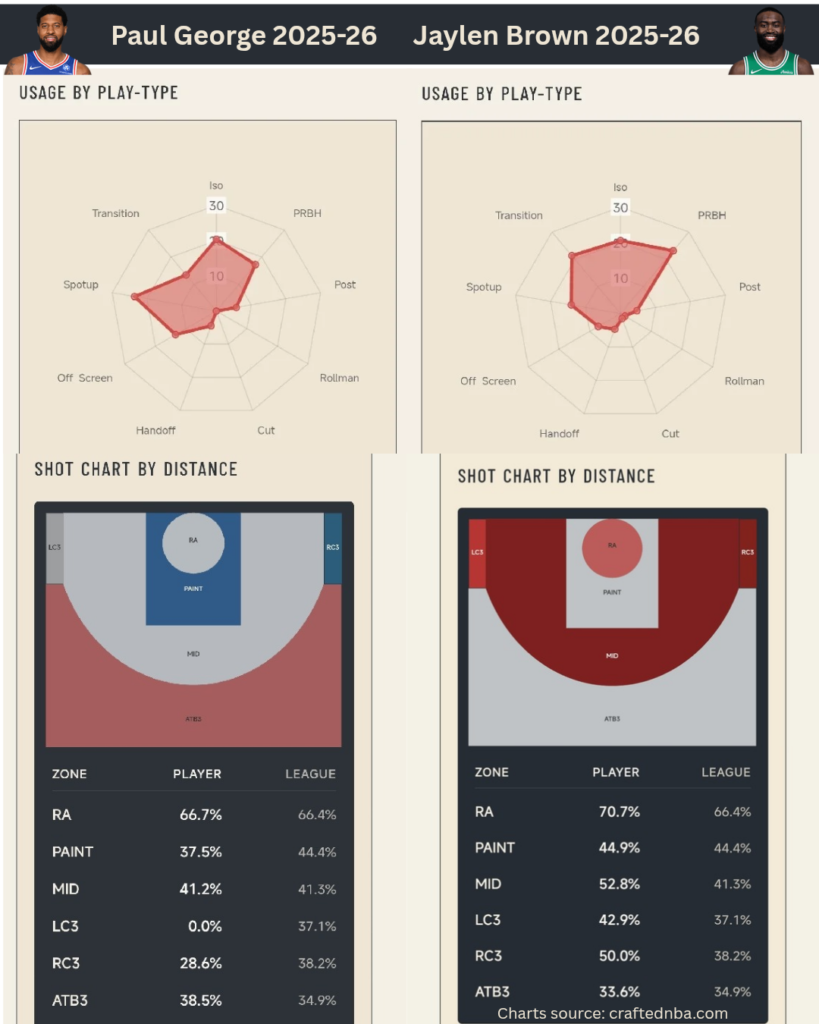
Boston’s front office spent the summer aggressive on two fronts: securing proven veterans and adding interior length via mid-level exceptions, while opening pathways for players on rookie deals or vet minimums to balance out high-earning contracts.
- Paul George (Acquired via Trade): $54,126,380 salary (32.8% of cap), replacing Brown’s high 35.1% usage rate with a complementary 23.3% usage profile to unlock 5-out spacing.
- Mitchell Robinson (Signed via NTMLE): $15,044,080 salary (9.1% of cap), using the Non-Taxpayer Mid-Level Exception to bring in an elite offensive rebounding and rim-protecting anchor.
- Mike Conley (Free Agent Veteran Minimum): $2,425,403 salary, bringing steady-handed, low-turnover point guard leadership off the bench.
- Draft Class Addition: Chris Cenac Jr. ($2.9M), adding explosive athleticism and high-motor defense as the single incoming rookie .
- Retained Core Rotation: Derrick White ($30.3M), Sam Hauser ($10.8M), Payton Pritchard ($7.7M), Hugo Gonzalez ($2.9M), Luka Garza ($2.8M), Baylor Scheierman ($2.7M), Neemias Queta ($2.6M), and Jordan Walsh ($2.4M).
Roster Flexibility & Open Spots
Boston carries 14 standard contracts and 2 two-way players (Amari Williams, Dillon Mitchell), leaving two spots technically up for grabs. However, realistically only the third two-way spot is in play—Brad Stevens has consistently made a habit of leaving the 15th standard roster spot open heading into training camp and opening night to preserve cap flexibility and maintain breathing room.
Salary Cap Mechanics and Second Apron Flexibility
Understanding where the Celtics stand ahead of training camp requires taking a close look at the Celtics cap sheet, which reflects a genius balance of star power and fiscal restraint. Far from being capped out, Boston actually sits comfortably with $1,705,594 in luxury tax space, $10,292,594 in 1st apron space, and a massive $22,963,594 buffer before reaching the dreaded 2nd apron line.
Deploying the NTMLE for Robinson was only possible because Boston stayed under the hard-cap apron thresholds. By staying under the tax threshold, Brad Stevens is actively resetting the franchise’s escalating repeater tax multipliers without sacrificing top-tier talent.
As the team looks down the road at a future Jayson Tatum contract extension, holding a $27.7 million Traded Player Exception gives Boston maximum flexibility to absorb another key contributor at the trade deadline if a title run demands it.
Rotation Breakdown and Tactical Questions
Head coach Joe Mazzulla faces a fascinating puzzle when blending this new core together. A projected opening lineup featuring Payton Pritchard, Derrick White, Paul George, Jayson Tatum, and Neemias Queta creates an ideal blend of perimeter shot-creation and interior defense. By replacing Brown’s 3.6 giveaways per game with George’s ball preservation (1.7 turnovers), Boston limits some of the live-ball turnovers that previously hurt their transition defense.
However, durability and age curves represent real risks. George enters his age-36 season, while Conley turns 39 shortly after opening night. Off the bench, Scheierman, Gonzalez and Hauser will be asked to carry heavier scoring burdens to preserve the health of the starters during the 82-game grind.
X-Factor and Young Core Growth
While holding flexibility under the tax line allows for potential mid-season moves, internal development remains the immediate key for Boston. Vacating over 35 wing minutes per game opens up immediate court time for promising wings Scheierman and Gonzalez, who both established themselves during their 2025-26 campaigns.
Per Cleaningtheglass.com highlight why Hugo Gonzalez proved ready for crucial minutes as a rookie: during his floor time last season, Boston posted a +9.5 point differential (93rd percentile) while forcing a +2.6% opponent turnover rate (95th percentile). Meanwhile, Scheierman (who shot 39.9% from deep on 243 attempts per 36 minutes) provides lethal floor spacing. Evaluating where the Celtics stand ahead of training camp makes it clear that if these returning young wings build on their emergent campaigns while George load-manages for the playoffs, Boston’s depth becomes truly elite.
Season Projection and Cap Outlook
Ultimately, examining where the Celtics stand ahead of training camp highlights a perfectly structured roster built to contend right now while preserving mid season options. Operating with genuine breathing room on the Celtics cap sheet, the sheer talent level of Jayson Tatum, Paul George, and Derrick White guarantees Boston a top-six seed in the Eastern Conference. However, unlike in previous seasons when they were a lock for 50+ wins, Boston might not get to that mark this year due to the sheer depth of the East.
Find me on X: @f_rederic_k


[…] just a salary dump. By replacing a high-usage co-star with a low-usage, off-ball elite shooter, the Celtics unlock a new offense while clearing rotation minutes for its developing wing […]