
NEW YORK — Summer League stat lines can easily trigger false alarm, and a cold shooting stretch in Las Vegas certainly caught the eye of New York fans. However, Mohamed Diawara’s Summer League struggles did not distort how the New York Knicks front office and coaching staff view his long-term upside. Just weeks before heading to Nevada, the Knicks locked in the 21-year-old French forward with a four-year, $11.2 million contract ($5.37 million guaranteed). That financial commitment signals clear internal alignment, confirming that the expanded Mohamed Diawara Knicks role remains firmly intact heading into the upcoming season.
Advanced Metrics Behind His Impact
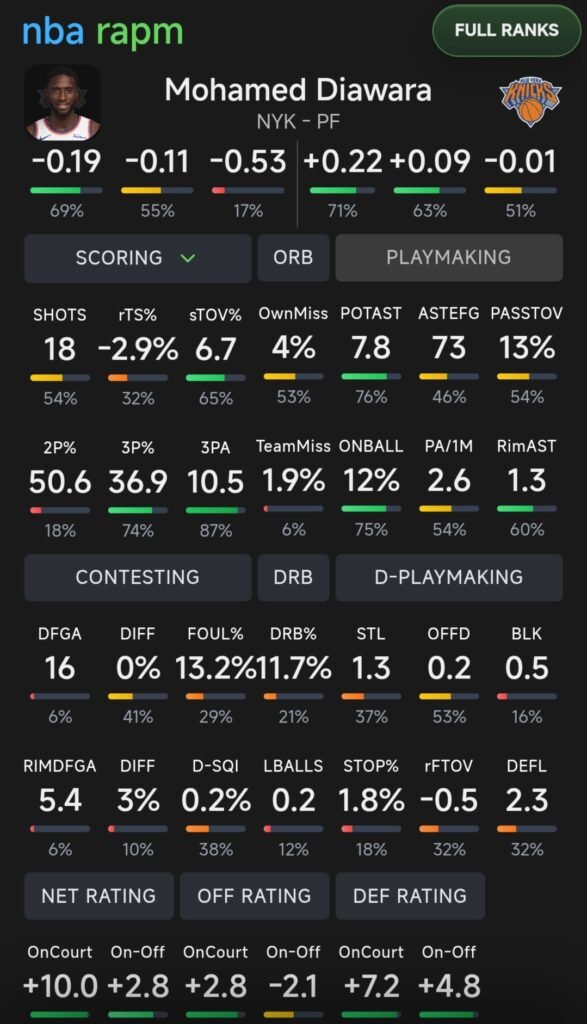
While box-score watchers panicked over his mid-summer slump, advanced tracking models show why New York values his profile. Per NBA RAPM tracking, Diawara proved to be a high-volume perimeter threat in his rookie campaign, shooting 36.9% from deep (74th percentile) on a 10.5 three-point attempt rate per 100 possessions (87th percentile). His low 50.6% two-point efficiency (18th percentile) and -2.9% relative True Shooting percentage highlight obvious room for growth inside the arc—the exact finishing issues exposed in Vegas—but his core value lies in spacing and defense.
Defensively, Diawara’s 6-foot-9 frame and 7-foot-4 wingspan anchor elite metrics. With Diawara on the floor, New York posted a +7.2 On-Court Defensive Rating (93rd percentile) and a dominant +10.0 On-Court Net Rating (96th percentile). Furthermore, the team was +2.8 points per 100 possessions better with him on the floor versus off. Mohamed Diawara’s Summer League struggles do not erase the reality that his perimeter spacing and length make him an impactful regular-season rotation piece.
The Clear Path to Rotation Minutes
A glance at New York’s salary cap sheet reveals a heavily guard-biased roster. With eight guards competing for backcourt minutes—including Jalen Brunson, Josh Hart, Miles McBride, Landry Shamet, Jose Alvarado, and Jordan Clarkson—the team’s frontcourt options are notably thin. Outside of Karl-Anthony Towns, OG Anunoby, Mikal Bridges and Andre Drummond, the roster lacks length.
When evaluating available Knicks frontcourt options, Diawara stands out as the primary small-ball wing/forward reserve. This positional scarcity gives him the clearest path to consistent playing time among the organization’s young developmental core:
- Tyler Kolek: Deeply buried on the point guard depth chart behind Brunson, Alvarado, and McBride.
- Pacome Dadiet: Blocked at the wing spot by Bridges, Hart, Shamet, and Clarkson. Beyond that, he’s played just 136 minutes across 29 appearances.
- Mohamed Diawara: Positioned as the direct backup behind Anunoby and Towns, where any extended absence or load-management night instantly thrusts him into a high-minute frontcourt role. Evaluating current Knicks roster depth, Diawara offers physical switching versatility that no secondary guard on the bench can replicate.
The Bottom Line
Bad shooting stretches in July mean nothing in the long run. As New York balances players’ minutes across an 82-game campaign, the Mohamed Diawara Knicks role will be vital to keeping the team healthy for a deep postseason run. Despite Mohamed Diawara’s Summer League struggles, his elite defensive upside and the Knicks’ lack of options secure his place as the roster’s premier wildcard. As Knicks roster depth gets tested throughout the year, expect Diawara to get significant opportunities.